Executive Summary (TL;DR)
For CIOs, IT Directors, and Quality Managers:
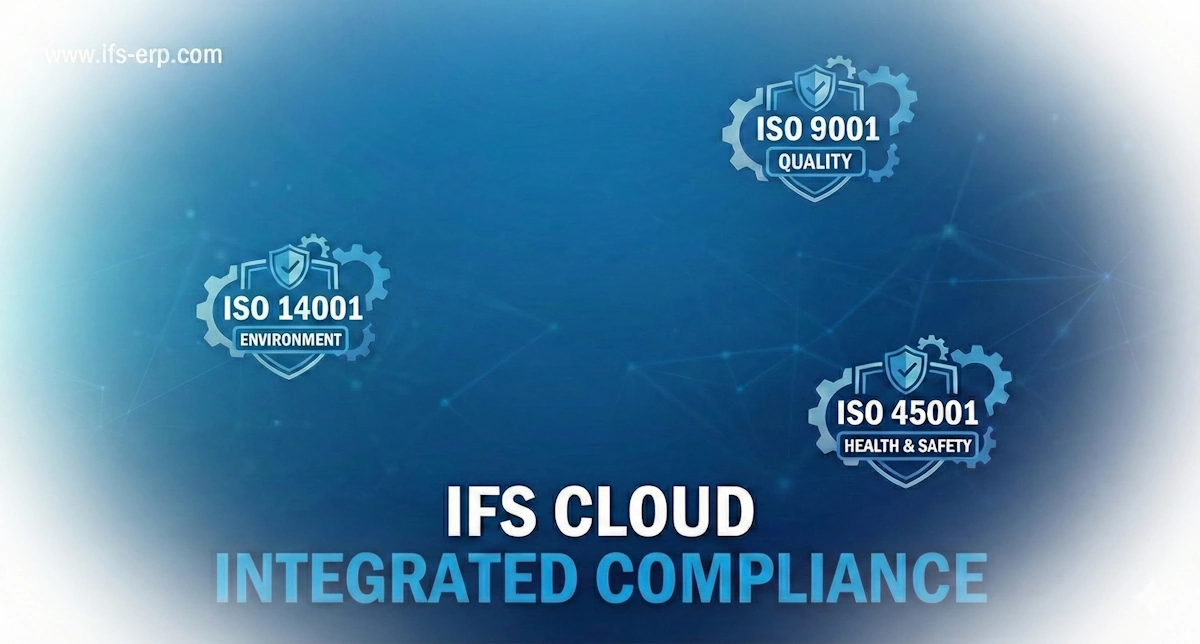
Transitioning to modern Cloud ERP environments like IFS Cloud™ presents a unique opportunity to dismantle the silos between your operational data and your compliance requirements. Traditionally, ISO 9001 (Quality), ISO 14001 (Environment), and ISO 45001 (Health & Safety) have been managed via disparate spreadsheets, third-party software, or physical paper trails. This fragmented approach increases risk, duplicates data entry, and fails to provide real-time insights.
This guide demonstrates how to utilize native ERP capabilities as a single, digital "Source of Truth" for your Integrated Management System (IMS). By embedding compliance controls directly into the ERP transactional flow—such as blocking a receipt from an unapproved vendor or preventing a work order assignment to an uncertified technician—you move from "compliance by inspection" to "compliance by design."
Core Takeaways:
-
Unified Data Model: A single audit trail links a customer complaint (ISO 9001) to a root cause analysis, or a chemical spill (ISO 14001) to the specific inventory batch and storage location.
-
Audit Velocity: Reduce external audit preparation time by up to 40% using "Lobby" dashboards that present real-time evidence to auditors without manual report compilation.
-
Active Risk Management: Replace static risk registers with dynamic controls. Use the system to physically stop processes (e.g., shipping, production) when compliance criteria are not met.
ISO 9001:2015 – Quality Management Systems
The standard for Quality Management is not just about product quality; it is about process consistency and customer satisfaction. Native ERP architecture covers this primarily through the Quality Management (QM) and Document Management (DocMan) modules.
Clause 7.5: Documented Information
ISO 9001 demands strict control over documents. In legacy systems, "Work Instructions" often drift out of sync with the actual process.
Implementation Strategy:
- Integrated Document Management (IDM): Configure your
Doc Classstructure to separate Policies, SOPs, and Forms. - Access Control: Use "Access Templates" to ensure that Obsolete documents are automatically hidden from the "Shop Floor Workbench" users.
- Visual Work Instructions: Attach media (PDFs, Videos) directly to the Routing Operation. When a shop floor operator opens a shop order operation, the latest approved instruction opens automatically.
Clause 8.4: Control of External Processes
You must ensure your suppliers meet your requirements. This goes beyond a one-time check.
Implementation Strategy:
- Supplier for Purchase Part (SFPP): Configure "Inspection Codes" to force mandatory incoming inspections for new vendors.
- Vendor Rating: Utilize the automatic Supplier Reliability calculation (delivery on time) and link it to quality stats.
- Solution: Set up a "Lobby" element that flags any Purchase Order creation for a supplier with an expired ISO 9001 certificate (tracked in
Supplier_Info_Address).
Addressing Clause 10.2: Non-conformity and Corrective Action
Do not manage NCRs in a separate "Quality" software. Use the integrated Non-Conformance Report (NCR) object. Configure the Corrective Action tab to be mandatory before the NCR status can move to "Closed". This enforces the "Check" and "Act" phases of the PDCA cycle directly in the transactional workflow.
ISO 14001:2015 – Environmental Management
This standard focuses on environmental performance and the "Lifecycle Perspective." Advanced ERP platforms support this via Eco-Footprint Management and Chemical Safety.
| ISO Requirement | Relevant Capability | Implementation Strategy |
|---|---|---|
| 6.1.2 Environmental Aspects | Eco-Footprint Management | Enable the Eco-Footprint component. Map emission factors (CO2, Water, Energy) to your Work Centers and Purchase Parts. This allows the system to calculate the environmental impact of a finished good based on its BOM and Routing, satisfying the "Lifecycle Perspective." |
| 6.1.3 Compliance Obligations | Document Management | Gap Note: ERPs do not natively stream global regulations. Action: Create a Document Class "REG" for your Legal Register (Permits, Laws). Set "Review Intervals" in DocMan to trigger reminders 90 days before a permit expires. |
| 8.1 Operational Planning | Maintenance (Asset Mgmt) | Identify environmentally critical equipment (e.g., Scrubbers, Waste Water Treatment). Create Preventive Maintenance (PM) Actions with a specific "CRITICALITY" flag. Use IoT connectors to trigger a PM if a sensor detects an emission breach. |
| 8.2 Emergency Preparedness | Incident Management | Configure Incident Class = "ENVIRONMENTAL". Train staff to log spills via the Mobile app immediately. This logs the time, location, and immediate containment actions, serving as vital evidence for auditors. |
ISO 45001:2018 – Occupational Health & Safety
Preventing work-related injury is paramount. Robust ERP systems integrate OHS directly into Human Capital Management (HCM) and Work Orders.
Clause 7.2: Competence
"Ensure that workers are competent on the basis of appropriate education, training, or experience."
The "Hard Stop" Configuration
One of the most powerful features is the ability to link Qualifications to Resource Management to prevent uncertified work.
Define a "License" in HCM for high-risk tasks (e.g., "Forklift Operation", "Confined Space Entry").
Assign this License to the specific Employee Profile with a valid-to date.
Critical Step: In the Maintenance Scheduling Optimization (MSO) or Service Dispatch, enable the constraint that checks for valid licenses.
Result: The system will fail to assign a work order to a technician if their safety certification has expired. This is irrefutable evidence of compliance.
Clause 5.4: Consultation and Participation of Workers
ISO 45001 requires non-managerial workers to participate. Use the Survey module to send out monthly "Safety Culture" surveys to shop floor users. The results can be aggregated anonymously and displayed in a Safety Lobby, demonstrating active worker engagement.
Source Data Prerequisites
Your system is only as compliant as the data within it. Before you enter the "Construct" phase, ensure the following datasets are cleansed and ready.
Quality Data
- Inspection Codes: Standardize your defect reasons (e.g., "Scratch", "Dimension", "Color").
- Variable Data: Define min/max tolerances for all critical attributes.
- Tool Calibration: List of all gauges, serial numbers, and last calibration dates.
Environmental
- Emission Factors: CO2e per kWh, Water usage per hour per work center.
- Waste Streams: List of EWC (European Waste Catalogue) codes you utilize.
- Hazardous Materials: CAS numbers and REACH status for all raw materials.
Safety Data
- Risk Library: Standard list of workplace hazards (Slip/Trip, Electrical, Noise).
- PPE Matrix: Which Personal Protective Equipment is required for which Job Role?
- Employee Certs: Scans of physical licenses and their expiry dates.