

Executive Summary (TL;TR)
Unlocking Hyperautomation: Integrating n8n with IFS Cloud represents the next frontier in operational efficiency.
- 🔹 Architecture: n8n offers a "fair-code" node-based workflow engine that can be self-hosted for maximum data sovereignty.
- 🔹 Integration: Seamless connection to IFS Cloud via OData REST APIs and OAuth2 authentication.
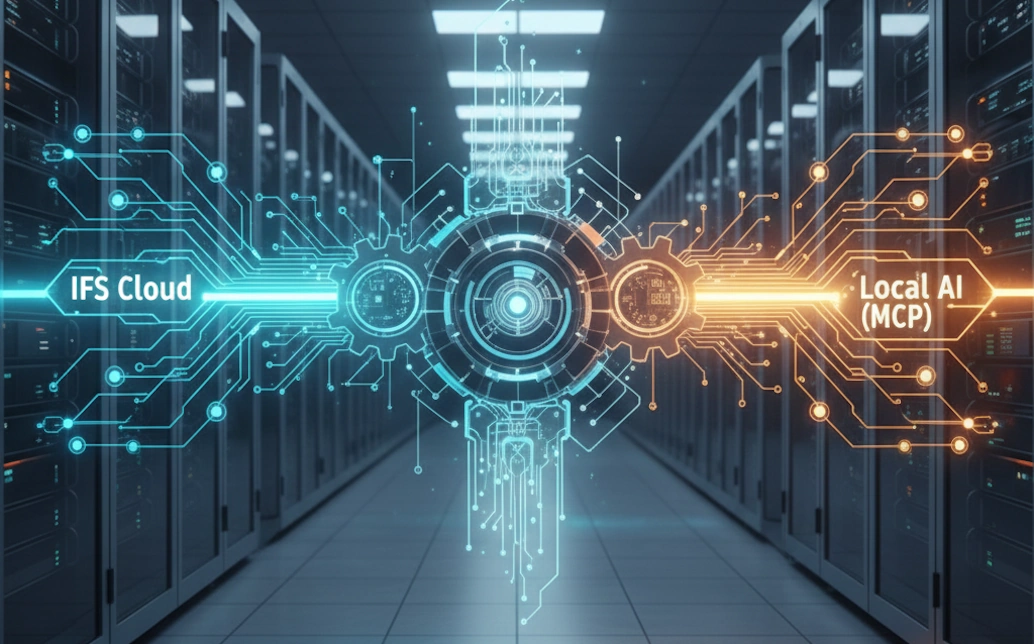
- 🔹 AI Innovation: Implementation of Model Context Protocol (MCP) allows local AI to process ERP data securely.
- 🔹 Business Value: Bridges the gap between core ERP functions and external SaaS ecosystems (Teams, Slack, Google Workspace).
The Strategic Synergy of n8n and IFS Cloud
In the modern enterprise landscape, IFS Cloud serves as the digital backbone of the organization, managing complex asset lifecycles, service management, and manufacturing processes. However, the agility of a business is often limited by how quickly data can move between the ERP and the myriad of peripheral applications used by employees daily.
This is where n8n enters the fray. Unlike traditional, rigid integration platforms, n8n provides a visual, node-based environment that empowers organizations to automate complex business logic without the overhead of heavy custom development. By leveraging "fair-code" principles, it offers the transparency of open-source with the power of enterprise-grade automation.
Why Enterprises are Choosing n8n for ERP Orchestration
Total Data Control
For IFS Cloud users, data security is paramount. n8n can be deployed via Docker on your own infrastructure, ensuring that sensitive financial or production data never traverses third-party servers.
Advanced AI Integration
With the recent introduction of the Model Context Protocol (MCP), n8n allows you to link local AI models to your IFS database, providing a "chat-with-your-data" experience that is both secure and intelligent.
Technical Deep-Dive: Connecting the Nodes
The integration between n8n and IFS Cloud is primarily achieved through the IFS OData API. This RESTful interface allows n8n to perform granular operations across all IFS functional areas.
Standard Integration Workflow:
- Authentication: Secure handshake using OAuth2 Client Credentials or Authorization Code flow.
- Projection Access: Targeting specific IFS Projections (e.g.,
PurchaseOrderHandlingorCustomerOrderHandling). - Data Transformation: Using n8n’s expressions or Function nodes to map ERP data into the format required by the destination system.
- Error Handling: Implementing "On Error" nodes to trigger alerts in Microsoft Teams if an API call fails.
Practical Business Applications
| Process Area | The Automation Bridge | Business Impact |
|---|---|---|
| Supply Chain | Auto-update IFS shipment tracking based on 17Track or DHL API webhooks. | 80% reduction in manual tracking queries. |
| Asset Management | IoT sensors trigger n8n workflows to create Service Requests in IFS Cloud automatically. | Predictive maintenance and reduced downtime. |
| Sales Operations | Syncing LinkedIn Lead Gen forms directly into IFS CRM Business Opportunities. | Zero lead leakage and faster response times. |
Frequently Asked Questions
Q: Can n8n handle high-volume data transfers for IFS Cloud?
A: Yes. By using n8n’s binary data processing and batching nodes, the platform can efficiently handle large datasets. For extreme volumes, we recommend self-hosting on a high-performance Docker environment.
Q: How does MCP improve the n8n experience?
A: The Model Context Protocol (MCP) allows your AI nodes in n8n to "understand" the context of your IFS data. It enables building tools where an AI can proactively search for information within your ERP to solve a user query.
Q: Is custom coding required?
A: While n8n is low-code, it allows for custom JavaScript in "Code Nodes." This is particularly useful for complex business logic in IFS that standard nodes cannot handle out of the box.
